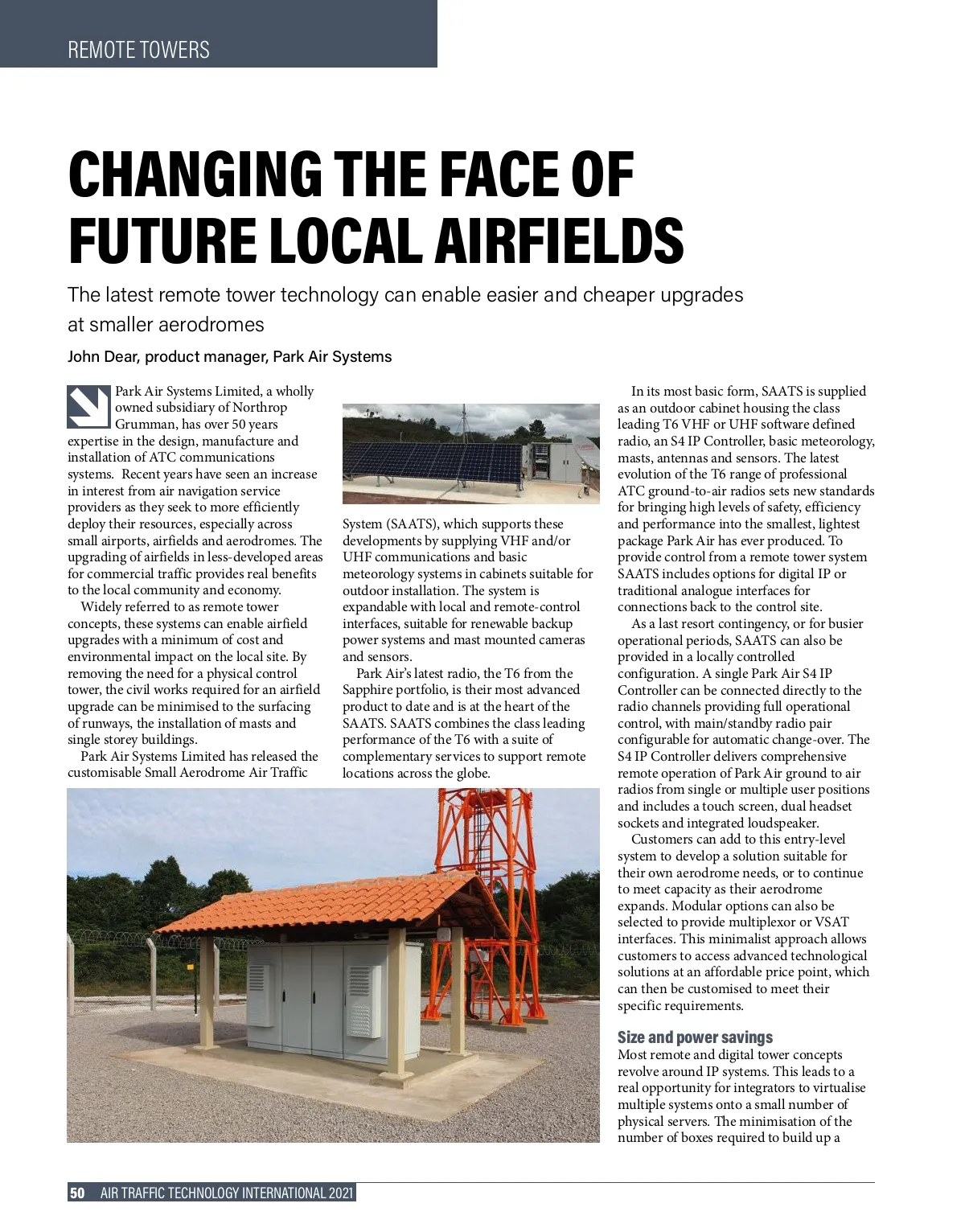
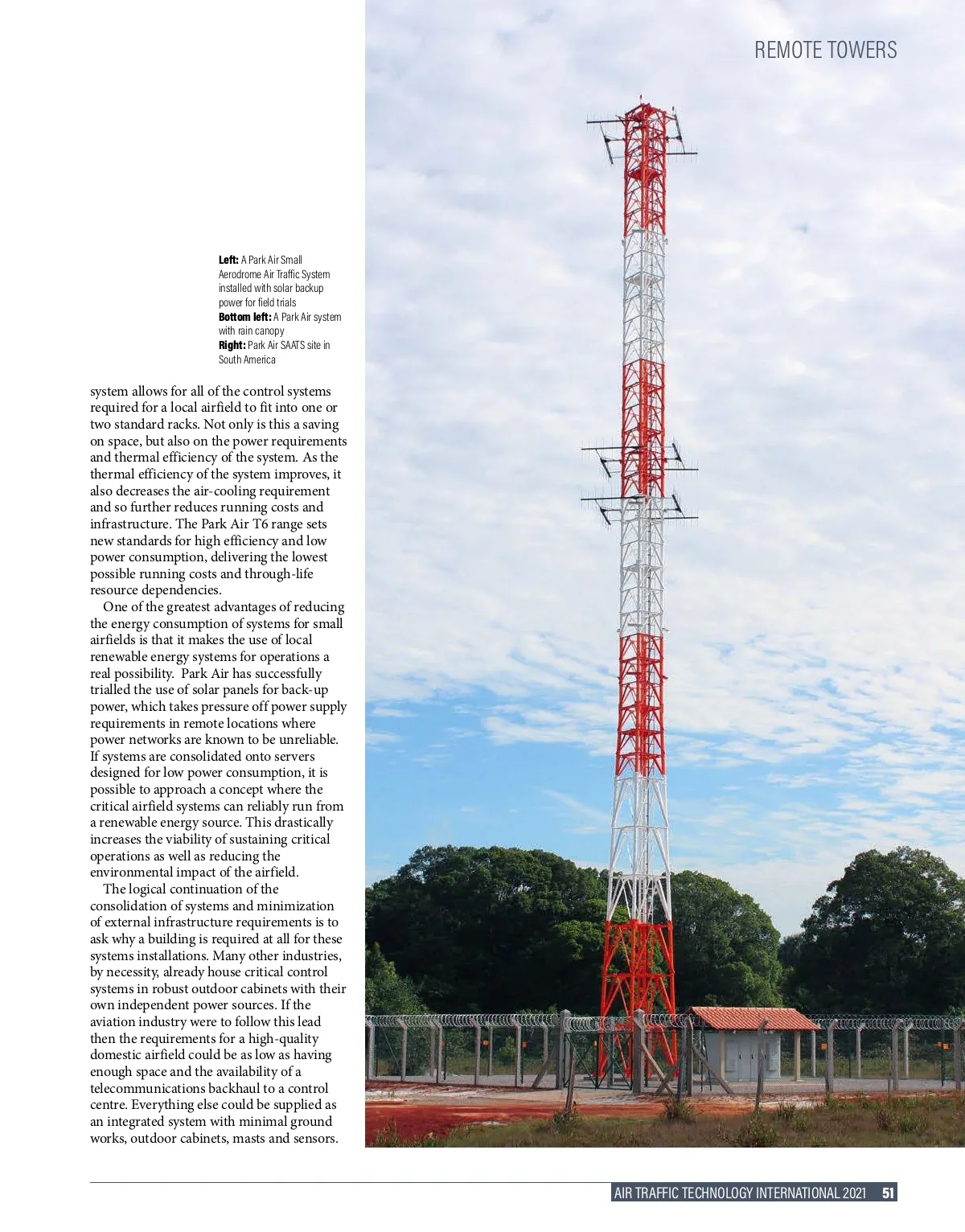
REMOTE TOWERS Left: A Park Air Small Aerodrome Air Traffic System installed with solar backup power for field trials Bottom left: A Park Air system with rain canopy Right: Park Air SAATS site in South America system allows for all of the control systems required for a local airfield to fit into one or two standard racks. Not only is this a saving on space, but also on the power requirements and thermal efficiency of the system. As the thermal efficiency of the system improves, it also decreases the air-cooling requirement and so further reduces running costs and infrastructure. The Park Air T6 range sets new standards for high efficiency and low power consumption, delivering the lowest possible running costs and through-life resource dependencies. One of the greatest advantages of reducing the energy consumption of systems for small airfields is that it makes the use of local renewable energy systems for operations a real possibility. Park Air has successfully trialled the use of solar panels for back-up power, which takes pressure off power supply requirements in remote locations where power networks are known to be unreliable. If systems are consolidated onto servers designed for low power consumption, it is possible to approach a concept where the critical airfield systems can reliably run from a renewable energy source. This drastically increases the viability of sustaining critical operations as well as reducing the environmental impact of the airfield. The logical continuation of the consolidation of systems and minimization of external infrastructure requirements is to ask why a building is required at all for these systems installations. Many other industries, by necessity, already house critical control systems in robust outdoor cabinets with their own independent power sources. If the aviation industry were to follow this lead then the requirements for a high-quality domestic airfield could be as low as having enough space and the availability of a telecommunications backhaul to a control centre. Everything else could be supplied as an integrated system with minimal ground works, outdoor cabinets, masts and sensors. AIR TRAFFIC TECHNOLOGY INTERNATIONAL 2021 51.
Air Traffic Technology 2021: Page 51